
Google Just Confirmed It: GEO Is Still SEO (And Here’s What That Actually Means)
SEO has been having a bit of an identity crisis. Between AI Overviews, AI Mode and everyone suddenly talking like a generative engine optimisation (GEO) expert, marketers have been left wondering if the rules changed overnight.
Google’s answer? Basically, no.
Google recently published its own official guidance on optimising for generative AI features in Search, covering AI Overviews, AI Mode, content, technical SEO, images, local businesses and ecommerce. It also rolled out dedicated generative AI performance reporting in Search Console, giving site owners a proper way to track their visibility in AI features.
The takeaway is refreshingly simple: GEO isn’t replacing SEO. It’s the same game, on a bigger board.

SEO Didn’t Disappear. Search Did.
Remember when searching meant typing a question into Google, scanning a list of blue links and clicking one? That experience is quietly changing.
AI can now summarise information, answer follow-up questions and pull information from multiple sources without making you open ten different tabs.
But here’s the part marketers shouldn’t miss: Google’s AI search still relies on its existing Search systems.
Google says its generative AI features are rooted in the same ranking and quality systems used across Search. There isn’t a completely separate AI search index where you need to start from scratch.
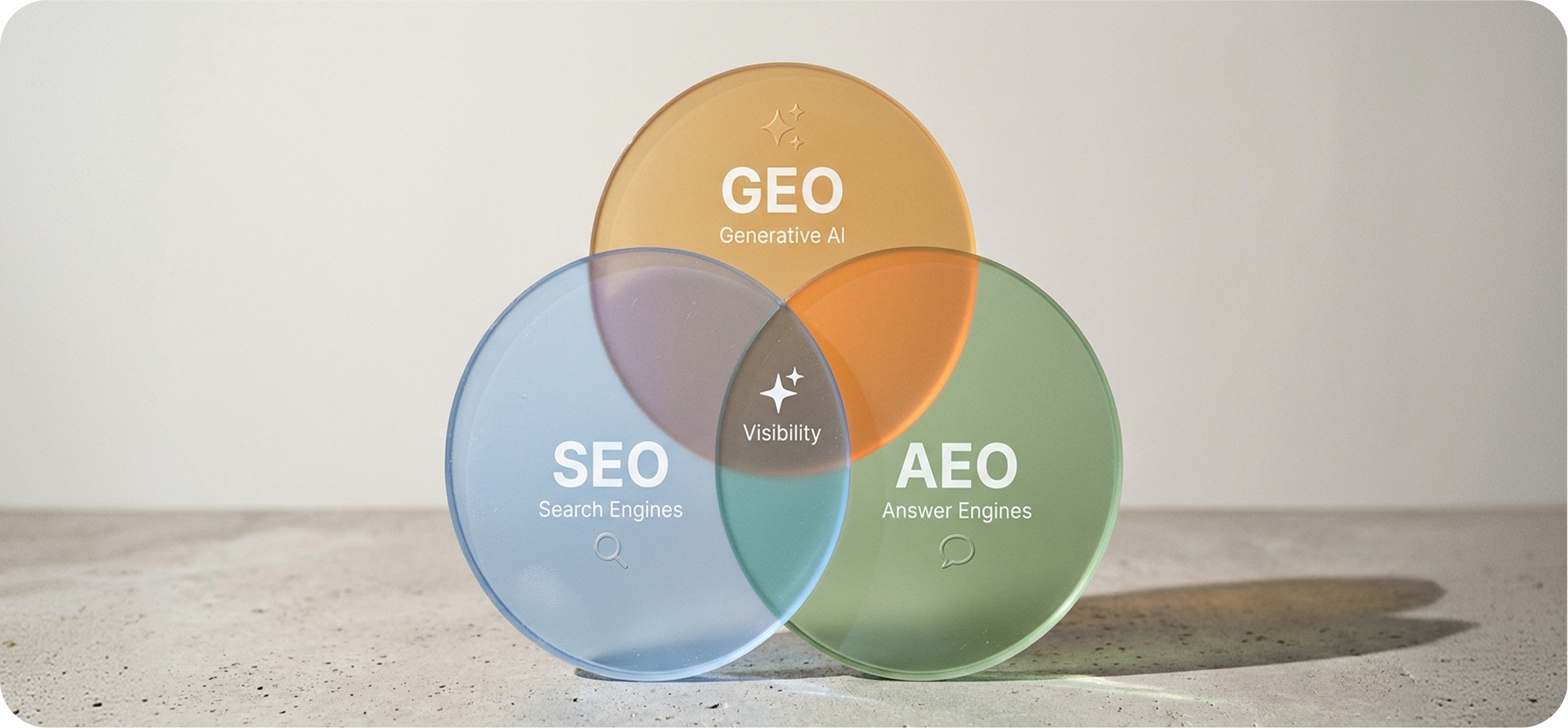
If you’ve been trying to work out AEO vs GEO vs SEO and where one ends and the other begins, you’re not alone. Marketers have thrown a lot of new labels at what is, underneath it all, still one job: help people find and trust your content.
Entrepreneur and SEO specialist Connor Gillivan put it plainly in a LinkedIn post breaking down the difference as:
“Good SEO is still the foundation. But it’s no longer the whole job. SEO earns you the ranking, AEO decides if you get extracted into an answer, and GEO decides if you get recommended by AI. Ranking #1 doesn’t guarantee either one now.”
So if your website already has solid technical SEO, useful content and pages that Google can crawl and index, you’re not starting over. You’re adapting.
GEO, What Does It Mean?
The name sounds fancier than it is.
Generative engine optimisation, or GEO, is really just about improving the chances of your content being cited as part of an AI-generated answer, which is a different game from the usual website ranking scenario, where you’re competing for a spot in a list of blue links. Some people call it AI SEO optimisation, but it’s the same underlying idea under a different label.
Google laid all of this out on 15 May 2026, in its official guidance on optimising for generative AI features on Google Search, published via the Google Search Central Blog. The guide confirms its systems use techniques like retrieval-augmented generation (RAG) and query fan-out to pull together an answer.
It’s a bit like packing for a road trip: ask yourself what you should check before setting off, and you’re already thinking about tyres, oil, battery health and servicing before the engine even starts. Writing for AI search works the same way: cover the related angles someone would actually need, not just answer the headline question.
A director within Google Search and former search liaison Danny Sullivan put it in one line that’s now doing the rounds in every marketing Slack channel: “Good SEO is good GEO.”
That’s basically the whole point.
Generic Content Is Getting Easier to Ignore
Here’s the biggest shift, and it’s not technical.
AI is brilliant at churning out generic content. Ask it for “10 benefits of digital marketing” and you’ll have a readable list in seconds. Nothing wrong with that, except the internet already has a thousand versions of it.
Now compare that to something like “what we learned managing 50 B2B lead generation campaigns.” That’s not something AI can invent from thin air. It needs real experience, data, mistakes and lessons that only actually happened to you.
Google’s guidance leans hard into this: content that goes beyond common knowledge, what it calls non-commodity content, is what actually stands out to both readers and AI systems. In practice, that means leaning on industry expertise, building trust and authority, and writing that’s backed by real research rather than recycled talking points.
As once quoted by Steve Jobs, “Creativity is just connecting things.”
That’s a pretty good way to think about content in the AI era.
Applied to content, that means connecting your own experience to the problem your audience actually has, rather than just repeating what’s already out there.
You Don’t Need to “GEO-ify” Your Website
The internet has produced a lot of GEO myths already: build an llms.txt file, chop everything into tiny chunks, add special AI markup, stuff every possible question into your copy.
Google’s guidance quietly shuts most of this down. You don’t need special AI files or markup to appear in Google’s generative AI features. It also says there is no requirement to “chunk” your content into tiny sections, and you don’t need to rewrite content simply to make it AI-friendly.
So instead of chasing every new GEO hack, focus on what actually helps users. That’s a much better use of your time.
Google Search team’s Analyst, Gary Illyes, made this even more explicit at a Search Central Deep Dive event in the Asia Pacific region, confirming that “When it comes to ranking in AI Overviews, all you need to do is normal SEO. He also said that Google won’t be crawling and using the new LLMS.txt files that have become a popular topic in the SEO space.”
So the file half the SEO internet has been rushing to create isn’t even in the picture.
The real lesson: don’t build a second SEO strategy just for AI. Build a better first one.
Does a Click Even Mean the Same Thing Anymore?
One of the biggest worries around AI search is obvious: if Google answers the question, why would anyone click through at all?
Google’s Head of Search, Elizabeth Reid, has pushed back on that framing directly. In an interview with the Financial Times, she said: “We see the clicks are of higher quality, because they’re not clicking on a webpage, realising it wasn’t what they want and immediately bailing. So, they spend more time on those sites. We see that it shows a greater diversity of websites that come up.”
Whether every publisher agrees is a different debate. But it does explain why “did I get a click” is becoming a less useful question than “did the right person land somewhere useful.”
You Can Now Actually See It Working
For two years, AI visibility was a black box; you’d see traffic dip but had no way to prove why. That changed on 3 June 2026, when Google introduced dedicated Search Generative AI performance reports in Search Console, giving site owners a proper view of impressions inside AI Overviews and AI Mode. It’s not perfect (no click data yet), but it means AI visibility is finally something you can measure, not just guess at.
Local SEO and the Boring Technical Stuff Still Matter
Local businesses aren’t off the hook either. Google points to tools like Google Business Profile and Merchant Centre as key sources for these AI-driven search experiences, so accurate opening hours, services and locations still carry weight.
And yes, the basics still count: crawlability, indexing, internal linking, page experience, mobile usability, site structure and useful HTML. Google says pages need to be indexed and eligible to appear in Search before they’re even considered for AI features. No amount of GEO cleverness saves a page Google can’t properly access in the first place.
The Next Big Thing: AI Agents
Search isn’t just changing how questions get answered, it’s starting to change how tasks get done. Google CEO Sundar Pichai addressed world leaders gathered at the AI Impact Summit in New Delhi, in February 2026, “no technology has me dreaming bigger than AI,” and AI agents are a big part of why.
These agents can compare products, complete tasks and interact with businesses directly. That means your website increasingly needs to make sense to three audiences at once: people, search engines, and AI agents. Clear structure and accessible content aren’t just nice to have anymore, they’re the baseline.
Basically, the cleaner your website is, the easier it becomes for different systems to understand what your business actually does.
So, Does SEO Still Work in 2026?
Yes. Completely.
But the old approach of publishing keyword-stuffed articles and hoping something sticks was never going to survive this shift anyway. Google’s latest guidance is actually reassuring. Its message is not “forget everything you know about SEO“. It’s almost the opposite.
Get the SEO fundamentals right. Create useful, original content. Keep your website technically sound. And above all, focus on people first.
Lily Ray, VP of SEO Strategy & Research at Amsive, made a similar point in a widely shared Search Engine Land piece. Having worked in SEO since 2010, she’s watched the industry survive plenty of “this changes everything” moments before, social signals, mobile-first indexing, voice search, even TikTok, and SEO came out stronger each time.
As she puts it, “AI search is simply the next frontier for SEO professionals to conquer.” (Read the full article)
Final Word: Generative Engine Optimisation Is the Next Chapter, Not a Replacement
The bigger picture is worth holding onto here. Search is evolving, but businesses still need strong websites, real expertise and content that actually helps people, not just algorithms.
So yes, generative engine optimisation matters. But it’s not a replacement for SEO; it’s the next chapter of it. As Google has now confirmed: good SEO is good GEO.