
Using AI Critique of Creative Work? Here’s Why It Backfires
Artificial intelligence is brilliant at a lot of things: summarising 80-page PDFs, calculating how many cupcakes you need for a birthday party, or whipping up ten simple addition problems for the kids' homework. Creative critique, however? You’re barking up the wrong tree entirely.
It might tell you your sentences are too long, your colour palette lacks contrast, or your pacing is off, because those are easy parameters to calculate. But true creative feedback isn't about mechanics; it’s about a gut reaction.
When you ask a machine to critique creative work, you trade away the genuine risks, the bold choices, and the quiet instincts that no spreadsheet or algorithm can ever anticipate.
Because when a machine looks at something truly original, it does not see art. It sees a statistical error.
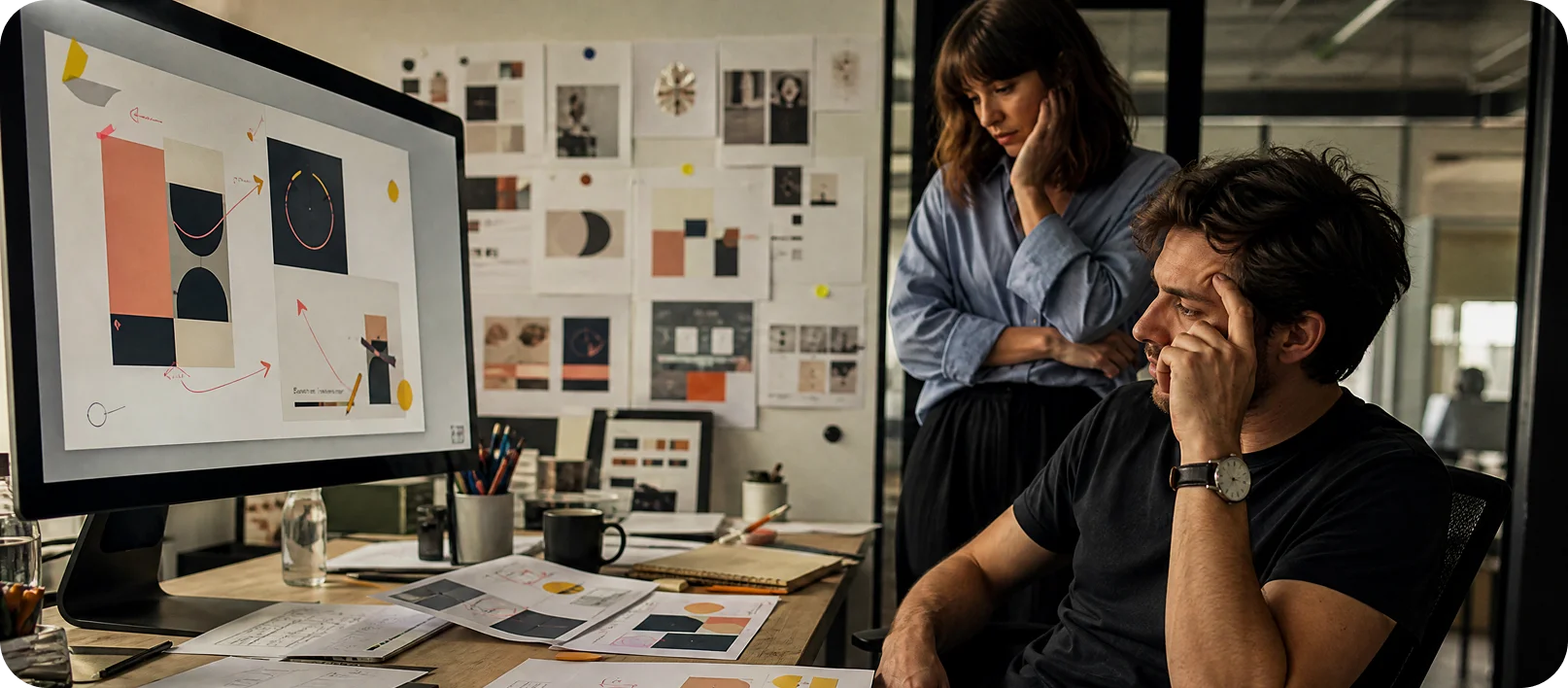
What Happens When Chatbots Take Over Creative Feedback
When LLMs become the main voice reviewing creative work, the feedback often loses the context, judgement and human understanding that shaped it in the first place. What started as a carefully considered piece of work can quickly turn into a game of Chinese whispers: each new prompt slightly twists the original intent until the result bears little resemblance to what was actually briefed.
For the designer or agency team, this creates endless, low-value revision cycles that have almost nothing to do with the strategy. For the client, it can feel like progress is being made, when in reality the work is simply being sanded down into a safer, more forgettable version of itself.
It Will Always Find Something Wrong
AI bots are designed to act as a helping aid. Ask a chatbot “What’s wrong with this?” and it will almost always find something, even when the work already meets the brief.
Change the wording of the prompt and the entire tone of the response can flip. One version gives you a list of faults. Another offers vague, polite suggestions. Many large language models (LLMs) are also trained to be agreeable, so they tend to mirror whatever the user already feels rather than push back.
What begins as a quick second opinion quickly turns into a loop of revisions. It’s the new “make the logo bigger” era, except this time the feedback is auto-generated, endlessly contradictory, and never sleeps.
Context Gets Left At The Door
AI has no memory of the strategy conversations, brand research, or the quiet decisions made three meetings ago. It simply averages the internet and hands back the middle ground. Distinctiveness is the first casualty.
One branding team spent weeks working on a project, carefully handling all the dos and don’ts of the brief, shaping the product to become the face of the brand while still holding on to its identity and ensuring it could stay unique in an ocean of similar brands.
AI models may be trained on vast amounts of information and can be given clear direction about what is expected. But it cannot trace the emotions behind the creative process or understand all the small decisions that shaped it.
Why Clients Reach For a Chatbot
The use of LLM bots is now so common that it has become a routine practice. Sometimes, there is no thought behind putting your own creativity and vision into an AI tool to get its opinion. It’s simply human to look for a third opinion in case you or your designer have missed something.
It’s the creative equivalent of bringing a confident friend in as the third wheel on a date.
There is also a greater sense of control. The knowledge base these bots hold can overwhelm anything a single person could know. Your designer might know 10 references, and you have gone through 20, but an LLM has access to hundreds and thousands of references. So, naturally, you want to take advantage of that.
But knowing more does not always mean knowing better. In the quest for perfection, it is very easy to lose the distinction, identity and the real version of your creative asset.

How Creative Professionals Should Respond To AI Feedback
So, how do you push back without sounding defensive or difficult?
1. Start With The Brief
As a creative professional, when you see AI-generated feedback entering the creative process, the first thing to do is go back to your starting point: the original creative brief sent by the client.
This gives you a chance to separate a genuine client concern from an AI-generated suggestion and consider whether the proposed change actually supports the strategy behind the work.
2. Protect The Work Before It Is Reviewed
One of the best moves you can make, and one that is now becoming standard practice among many freelancers and studios, is to be transparent about the use of LLM tools for feedback on creative work.
From the beginning of the project, there should be clarity around what stages these tools can be introduced at and to what extent.
The major concern is that some platforms can flag AI-generated content, such as the AI information tags that appear above some Instagram posts.
So, if a creative draft is put into an AI tool, there is a higher risk of it being flagged or associated with AI-generated content. This is why it is important to protect the work.
Add clear clauses to project contracts and set expectations that deliverables are not to be uploaded into public AI models, and that AI-generated feedback will not be accepted as a basis for revisions.
It’s all about protecting intellectual property and keeping the conversation human. Think of it as a terms-and-conditions reality check and a polite way of saying, “Please don’t train the internet on my unfinished work.”
3. Move The Conversation Out Of The Chatbot
Another option is to set up a meeting and present the work to get an honest opinion on what has been done. A better option is to set up a real-time meeting, either face to face or on a video call, and present the work while it is on screen.
Let the client react and speak freely. When they refer to feedback generated by a chatbot, they then have to explain and defend it themselves rather than leaving you to carry the burden of arguing against an algorithm.
And if none of the sensible approaches works, there’s always the slightly chaotic option: ask your favourite LLM why this feedback is wrong, then send that reply back.
After all, these are essentially yes-bots. They just work hard to agree with whoever’s asking the questions.
Why Creative Judgement Still Belongs to Humans
There’s a quiet irony in all this. The more sophisticated the tools become, the more valuable genuine human judgement starts to look. AI can help us move faster. It cannot decide what is worth saying, or how bravely we are willing to say it.
So the next time the suggestion comes up, “just run it through AI first,” you might smile and say, “happy to use it as a tool.” The judgement stays human.
How To Use AI For Smarter Creative Feedback
AI can be a useful second pair of eyes, as long as you direct it properly.
The biggest mistake is asking vague questions like “Is this any good?” You usually get polite, generic answers that don’t help much. Instead, give the tool a clear role and specific criteria.
For Getting Feedback on Individual Creative Work
Try something like:
| “I’m designing a landing page for a sustainability brand aimed at young professionals. Review this design for hierarchy and visual flow, typography choices, colour harmony, and whether it feels trustworthy and modern.” |
When something feels off, get more precise:
| “This layout feels unbalanced. Suggest specific changes to spacing, alignment or visual weight that would improve it.” |
For Brand Checks
“Here are the main brand guidelines [paste the key points]. Does this design follow them? Point out anything that feels off-brand.”
Just remember it’s still only a tool. After all, an AI critique of creative work can tell you what looks unusual, what might be changed and what follows familiar patterns. But it cannot understand why a creative decision was made, what the work is trying to achieve, or when breaking the rules is exactly the point.
If the goal of creative work was to produce the most statistically average version of itself, we wouldn’t need artists. We’d just need better averages. And frankly, the world already has enough of those.
Before You Ask an AI Bot, Ask Yourself
The point isn’t to keep AI tools out of the creative process entirely. It is to know where their role ends.
Use it to challenge an idea, spot something you may have missed, or explore a fresh perspective on your initial draft. But don’t let it become the voice that decides whether your creative work is good, bad or worth keeping.
Because sometimes the thing an AI suggests you fix is the very thing that makes the work yours.
So, the next time you’re tempted to type, “What’s wrong with this?” in your LLM, perhaps ask yourself first: Am I looking for useful feedback, or to validate my doubts?